Powered By Blogger

Wednesday, 6 May 2020

TODAY IN HISTORY

The Scream: I found the stolen painting - BBC News

Edvard Munch’s "The Scream" recovered after theft

On May 7, 1994, Norway’s most famous painting, “The Scream” by Edvard Munch, is recovered almost three months after it was stolen from a museum in Oslo. The fragile painting was recovered undamaged at a hotel in Asgardstrand, about 40 miles south of Oslo, police said.

The iconic 1893 painting of a waiflike figure on a bridge was stolen in only 50 seconds during a break-in on February 12, the opening day of the 1994 Winter Olympics in Lillehammer. Two thieves broke through a window of the National Gallery, cut a wire holding the painting to the wall and left a note reading “Thousand thanks for the bad security!”

A few days after the theft, a Norwegian anti-abortion group said it could have the painting returned if Norwegian television showed an anti-abortion film. The claim turned out to be false. The government also received a $1 million ransom demand on March 3, but refused to pay it due to a lack of proof that the demand was genuine.

READ MORE: History's Biggest Art Heist

Eventually, police found four pieces of the painting’s frame in Nittedal, a suburb north of Oslo, and what may have been a cryptic messages that the thieves wanted to discuss a ransom. Finally, in January 1996, four men were convicted and sentenced in connection with the theft. They included Paal Enger, who had been convicted in 1988 of stealing Munch’s “The Vampire” in Oslo. Enger was sentenced this time to six-and-a-half-years in prison. He escaped while on a field trip in 1999, and was captured 12 days later in a blond wig and dark sunglasses trying to buy a train ticket to Copenhagen.


In August 2004, another version of “The Scream” was stolen along with Munch’s “The Madonna,” this time from the Munch Museum in Oslo. Three men were convicted in connection with that theft in May 2006. Police recovered both works in August with minor marks and tears. Yet another version of “The Scream” remained in private hands and sold on May 2, 2012, for $119.9 million.

Munch developed an emotionally charged style that served as an important forerunner of the 20th century Expressionist movement. He painted “The Scream” as part of his “Frieze of Life” series, in which sickness, death, fear, love and melancholy are central themes. He died in January 1944 at the age of 81.

TODAY IN HISTORY


English Channel tunnel opens

In a ceremony presided over by England’s Queen Elizabeth II and French President Francois Mitterrand, a rail tunnel under the English Channel was officially opened, connecting Britain and the European mainland for the first time since the Ice Age.

The Channel Tunnel, or “Chunnel,” connects Folkestone, England, with Coquelles, France, 31 miles away. The Chunnel cut travel time between England and France to a swift 35 minutes and eventually between London and Paris to two-and-a-half hours.

As the world’s longest undersea tunnel, the Chunnel runs under water for 23 miles, with an average depth of 150 feet below the seabed. Each day, about 30,000 people, 6,000 cars and 3,500 trucks journey through the Chunnel on passenger, shuttle and freight trains.

Millions of tons of earth were moved to build the two rail tunnels—one for northbound and one for southbound traffic—and one service tunnel. Fifteen thousand people were employed at the peak of construction. Ten people were killed during construction.

Napoleon’s engineer, Albert Mathieu, planned the first tunnel under the English Channel in 1802, envisioning an underground passage with ventilation chimneys that would stretch above the waves. In 1880, the first real attempt was made by Colonel Beaumont, who bore a tunnel more than a mile long before abandoning the project. Other efforts followed in the 20th century, but none on the scale of the tunnels begun in June 1988.

The Chunnel’s $16 billion cost was roughly twice the original estimate, and completion was a year behind schedule. One year into service, Eurotunnel announced a huge loss, one of the biggest in United Kingdom corporate history at the time. A scheme in which banks agreed to swap billions of pounds worth of loans for shares saved the tunnel from going under and it showed its first net profit in 1999.


Tuesday, 5 May 2020

TODAY IN HISTORY


Alan B. Shepard | Hack the Moon

Alan Shepard First American in Space

From Cape Canaveral, Florida, Navy Commander Alan Bartlett Shepard Jr. is launched into space aboard the Freedom 7 space capsule, becoming the first American astronaut to travel into space. The suborbital flight, which lasted 15 minutes and reached a height of 116 miles into the atmosphere, was a major triumph for the National Aeronautics and Space Administration (NASA).

NASA was established in 1958 to keep U.S. space efforts abreast of recent Soviet achievements, such as the launching of the world’s first artificial satellite–Sputnik 1–in 1957. In the late 1950s and early 1960s, the two superpowers raced to become the first country to put a man in space and return him to Earth. On April 12, 1961, the Soviet space program won the race when cosmonaut Yuri Gagarin was launched into space, put in orbit around the planet, and safely returned to Earth. One month later, Shepard’s suborbital flight restored faith in the U.S. space program.

NASA continued to trail the Soviets closely until the late 1960s and the successes of the Apollo lunar program. In July 1969, the Americans took a giant leap forward with Apollo 11, a three-stage spacecraft that took U.S. astronauts to the surface of the moon and returned them to Earth. On February 5, 1971, Alan Shepard, the first American in space, became the fifth astronaut to walk on the moon as part of the Apollo 14 lunar landing mission.

Sunday, 3 May 2020

TODAY IN HISTORY

Kent State Shootings: A Timeline of the Tragedy - HISTORY

National Guard kills four students in Kent State shootings


On May 4, 1970, in Kent, Ohio, 28 National Guardsmen fire their weapons at a group of anti-war demonstrators on the Kent State University campus, killing four students, wounding eight, and permanently paralyzing another. The tragedy was a watershed moment for a nation divided by the conflict in Vietnam, and further galvanized the anti-war movement. 

Two days earlier, on May 2, National Guard troops were called to Kent to suppress students rioting in protest of the Vietnam War and the U.S. invasion of Cambodia. The next day, scattered protests were dispersed by tear gas, and on May 4 class resumed at Kent State University. By noon that day, despite a ban on rallies, some 2,000 people had assembled on the campus. National Guard troops arrived and ordered the crowd to disperse, fired tear gas, and advanced against the students with bayonets fixed on their rifles. Some of the protesters, refusing to yield, responded by throwing rocks and verbally taunting the troops.

READ MORE: Kent State Shootings: A Timeline of the Tragedy

Minutes later, without firing a warning shot, the Guardsmen discharged more than 60 rounds toward a group of demonstrators in a nearby parking lot, killing four and wounding nine. The closest casualty was 20 yards away, and the farthest was almost 250 yards away. After a period of disbelief, shock, and attempts at first aid, angry students gathered on a nearby slope and were again ordered to move by the Guardsmen. Faculty members were able to convince the group to disperse, and further bloodshed was prevented.

The shootings led to protests on college campuses across the country. Photographs of the massacre became enduring images of the anti-war movement. In 1974, at the end of a criminal investigation, a federal court dropped all charges levied against eight Ohio National Guardsmen for their role in the Kent State students’ deaths. 


TODAY IN HISTORY

Niccolo Machiavelli: Fear and Love - Modern Theory - Medium

Italian philosopher and writer Niccolo Machiavelli born

On May 3, 1469, the Italian philosopher and writer Niccolo Machiavelli is born. A lifelong patriot and diehard proponent of a unified Italy, Machiavelli became one of the fathers of modern political theory.

Machiavelli entered the political service of his native Florence by the time he was 29. As defense secretary, he distinguished himself by executing policies that strengthened Florence politically. He soon found himself assigned diplomatic missions for his principality, through which he met such luminaries as Louis XII of France, Pope Julius II, the Holy Roman Emperor Maximilian I, and perhaps most importantly for Machiavelli, a prince of the Papal States named Cesare Borgia. The shrewd and cunning Borgia later inspired the title character in Machiavelli’s famous and influential political treatise The Prince (1532).

Machiavelli’s political life took a downward turn after 1512, when he fell out of favor with the powerful Medici family. He was accused of conspiracy, imprisoned, tortured and temporarily exiled. It was an attempt to regain a political post and the Medici family’s good favor that Machiavelli penned The Prince, which was to become his most well-known work.

Though released in book form posthumously in 1532, The Prince was first published as a pamphlet in 1513. In it, Machiavelli outlined his vision of an ideal leader: an amoral, calculating tyrant for whom the end justifies the means. The Prince not only failed to win the Medici family’s favor, it also alienated him from the Florentine people. 


Machiavelli was never truly welcomed back into politics, and when the Florentine Republic was reestablished in 1527, Machiavelli was an object of great suspicion. He died later that year, embittered and shut out from the Florentine society to which he had devoted his life.

Though Machiavelli has long been associated with the practice of diabolical expediency in the realm of politics that was made famous in The Prince, his actual views were not so extreme. In fact, in such longer and more detailed writings as Discourses on the First Ten Books of Livy (1517) and History of Florence (1525), he shows himself to be a more principled political moralist. Still, even today, the term “Machiavellian” is used to describe an action undertaken for gain without regard for right or wrong.

Saturday, 2 May 2020

HISTORY FOR TODAY

Legend of Loch Ness Monster Born - HISTORY

Loch Ness "Monster" sighted for the first time, igniting the modern legend

The modern legend of the Loch Ness Monster is born when a sighting makes local news on May 2, 1933. The newspaper Inverness Courier relates an account of a local couple who claim to have seen “an enormous animal rolling and plunging on the surface.” The story of the “monster” (a moniker chosen by the Courier editor) becomes a media phenomenon, with London newspapers sending correspondents to Scotland and a circus offering a 20,000 pound sterling reward for capture of the beast.

After the April 1933 sighting was reported in the newspaper on May 2, interest steadily grew, especially after another couple claimed to have seen the animal on land.

Amateur investigators have for decades kept an almost constant vigil, and in the 1960s several British universities launched sonar expeditions to the lake. Nothing conclusive was found, but in each expedition the sonar operators detected some type of large, moving underwater objects. In 1975, another expedition combined sonar and underwater photography in Loch Ness. A photo resulted that, after enhancement, appeared to show what vaguely resembled the giant flipper of an aquatic animal.

Further sonar expeditions in the 1980s and 1990s resulted in more inconclusive readings. Revelations in 1994 that the famous 1934 photo was a complete hoax has only slightly dampened the enthusiasm of tourists and investigators for the legendary beast of Loch Ness.

Friday, 1 May 2020

TODAY IN HISTORY

Empire State Building dedicated

On May 1, 1931, President Herbert Hoover officially dedicates New York City’s Empire State Building, pressing a button from the White House that turns on the building’s lights. Hoover’s gesture, of course, was symbolic; while the president remained in Washington, D.C., someone else flicked the switches in New York.

The idea for the Empire State Building is said to have been born of a competition between Walter Chrysler of the Chrysler Corporation and John Jakob Raskob of General Motors, to see who could erect the taller building. Chrysler had already begun work on the famous Chrysler Building, the gleaming 1,046-foot skyscraper in midtown Manhattan. Not to be bested, Raskob assembled a group of well-known investors, including former New York Governor Alfred E. Smith. The group chose the architecture firm Shreve, Lamb and Harmon Associates to design the building. The Art-Deco plans, said to have been based in large part on the look of a pencil, were also builder-friendly: The entire building went up in just over a year, under budget (at $40 million) and well ahead of schedule. During certain periods of building, the frame grew an astonishing four-and-a-half stories a week.

At the time of its completion, the Empire State Building, at 102 stories and 1,250 feet high (1,454 feet to the top of the lightning rod), was the world’s tallest skyscraper. The Depression-era construction employed as many as 3,400 workers on any single day, most of whom received an excellent pay rate, especially given the economic conditions of the time. The new building imbued New York City with a deep sense of pride, desperately needed in the depths of the Great Depression, when many city residents were unemployed and prospects looked bleak. The grip of the Depression on New York’s economy was still evident a year later, however, when only 25 percent of the Empire State’s offices had been rented.


In 1972, the Empire State Building lost its title as world’s tallest building to New York’s World Trade Center, which itself was the tallest skyscraper for but a year. Today the honor belongs to Dubai’s Burj Khalifa tower, which soars 2,716 feet into the sky.

Thursday, 30 April 2020

TODAY IN HISTORY


Adolf Hitler commits suicide in his underground bunker

On April 30, 1945, holed up in a bunker under his headquarters in Berlin, Adolf Hitler commits suicide by swallowing a cyanide capsule and shooting himself in the head. Soon after, Germany unconditionally surrendered to the Allied forces, ending Hitler’s dreams of a “1,000-year” Reich.

Since at least 1943, it was becoming increasingly clear that Germany would fold under the pressure of the Allied forces. In February of that year, the German 6th Army, lured deep into the Soviet Union, was annihilated at the Battle of Stalingrad, and German hopes for a sustained offensive on both fronts evaporated. Then, in June 1944, the Western Allied armies landed at Normandy, France, and began systematically to push the Germans back toward Berlin. By July 1944, several German military commanders acknowledged their imminent defeat and plotted to remove Hitler from power so as to negotiate a more favorable peace. Their attempts to assassinate Hitler failed, however, and in his reprisals, Hitler executed over 4,000 fellow countrymen.

In January 1945, facing a siege of Berlin by the Soviets, Hitler withdrew to his bunker to live out his final days. Located 55 feet under the chancellery, the shelter contained 18 rooms and was fully self-sufficient, with its own water and electrical supply. Though he was growing increasingly mad, Hitler continued to give orders and meet with such close subordinates as Hermann Goering, Heinrich Himmler and Josef Goebbels. He also married his long-time mistress Eva Braun just one day before his suicide.


In his last will and testament, Hitler appointed Admiral Karl Donitz as head of state and Goebbels as chancellor. He then retired to his private quarters with Braun, where he and Braun poisoned themselves and their dogs, before Hitler then also shot himself with his service pistol.

Hitler and Braun’s bodies were hastily cremated in the chancellery garden, as Soviet forces closed in on the building. When the Soviets reached the chancellery, they removed Hitler’s ashes, continually changing their location so as to prevent Hitler devotees from creating a memorial at his final resting place. Only eight days later, on May 8, 1945, the German forces issued an unconditional surrender, leaving Germany to be carved up by the four Allied powers.

Wednesday, 9 November 2016

Today in history

1938

Nazis launch Kristallnacht


On this day in 1938, in an event that would foreshadow the Holocaust, German Nazis launch a campaign of terror against Jewish people and their homes and businesses in Germany and Austria. The violence, which continued through November 10 and was later dubbed “Kristallnacht,” or “Night of Broken Glass,” after the countless smashed windows of Jewish-owned establishments, left approximately 100 Jews dead, 7,500 Jewish businesses damaged and hundreds of synagogues, homes, schools and graveyards vandalized. An estimated 30,000 Jewish men were arrested, many of whom were then sent to concentration camps for several months; they were released when they promised to leave Germany. Kristallnacht represented a dramatic escalation of the campaign started by Adolf Hitler in 1933 when he became chancellor to purge Germany of its Jewish population.
The Nazis used the murder of a low-level German diplomat in Paris by a 17-year-old Polish Jew as an excuse to carry out the Kristallnacht attacks. On November 7, 1938, Ernst vom Rath was shot outside the German embassy by Herschel Grynszpan, who wanted revenge for his parents’ sudden deportation from Germany to Poland, along with tens of thousands of other Polish Jews. Following vom Rath’s death, Nazi propaganda minister Joseph Goebbels ordered German storm troopers to carry out violent riots disguised as “spontaneous demonstrations” against Jewish citizens. Local police and fire departments were told not to interfere. In the face of all the devastation, some Jews, including entire families, committed suicide.
In the aftermath of Kristallnacht, the Nazis blamed the Jews and fined them 1 billion marks (or $400 million in 1938 dollars) for vom Rath’s death. As repayment, the government seized Jewish property and kept insurance money owed to Jewish people. In its quest to create a master Aryan race, the Nazi government enacted further discriminatory policies that essentially excluded Jews from all aspects of public life.
Over 100,000 Jews fled Germany for other countries after Kristallnacht. The international community was outraged by the violent events of November 9 and 10. Some countries broke off diplomatic relations in protest, but the Nazis suffered no serious consequences, leading them to believe they could get away with the mass murder that was the Holocaust, in which an estimated 6 million European Jews died.

Tuesday, 8 November 2016

Today in history

1895

German scientist discovers X-rays


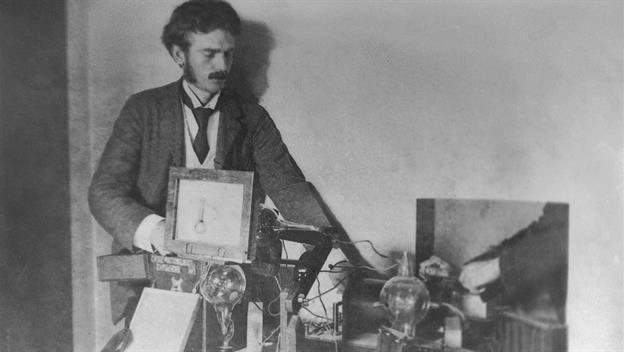
On this day in 1895, physicist Wilhelm Conrad Rontgen (1845-1923) becomes the first person to observe X-rays, a significant scientific advancement that would ultimately benefit a variety of fields, most of all medicine, by making the invisible visible. Rontgen’s discovery occurred accidentally in his Wurzburg, Germany, lab, where he was testing whether cathode rays could pass through glass when he noticed a glow coming from a nearby chemically coated screen. He dubbed the rays that caused this glow X-rays because of their unknown nature.
X-rays are electromagnetic energy waves that act similarly to light rays, but at wavelengths approximately 1,000 times shorter than those of light. Rontgen holed up in his lab and conducted a series of experiments to better understand his discovery. He learned that X-rays penetrate human flesh but not higher-density substances such as bone or lead and that they can be photographed.
Rontgen’s discovery was labeled a medical miracle and X-rays soon became an important diagnostic tool in medicine, allowing doctors to see inside the human body for the first time without surgery. In 1897, X-rays were first used on a military battlefield, during the Balkan War, to find bullets and broken bones inside patients.
Scientists were quick to realize the benefits of X-rays, but slower to comprehend the harmful effects of radiation. Initially, it was believed X-rays passed through flesh as harmlessly as light. However, within several years, researchers began to report cases of burns and skin damage after exposure to X-rays, and in 1904, Thomas Edison’s assistant, Clarence Dally, who had worked extensively with X-rays, died of skin cancer. Dally’s death caused some scientists to begin taking the risks of radiation more seriously, but they still weren’t fully understood. During the 1930s, 40s and 50s, in fact, many American shoe stores featured shoe-fitting fluoroscopes that used to X-rays to enable customers to see the bones in their feet; it wasn’t until the 1950s that this practice was determined to be risky business. Wilhelm Rontgen received numerous accolades for his work, including the first Nobel Prize in physics in 1901, yet he remained modest and never tried to patent his discovery. Today, X-ray technology is widely used in medicine, material analysis and devices such as airport security scanners.

Friday, 4 November 2016

Today in History

1956

Soviets put brutal end to Hungarian revolution


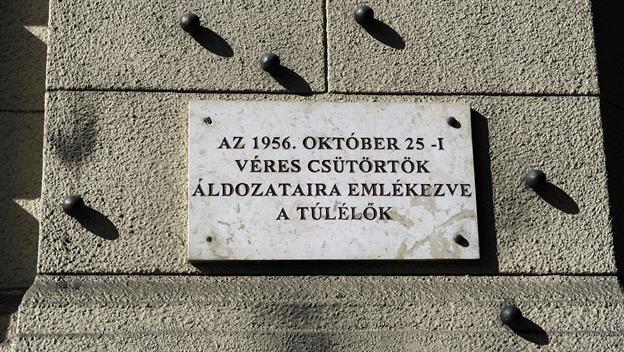
A spontaneous national uprising that began 12 days before in Hungary is viciously crushed by Soviet tanks and troops on this day in 1956. Thousands were killed and wounded and nearly a quarter-million Hungarians fled the country.
The problems in Hungary began in October 1956, when thousands of protesters took to the streets demanding a more democratic political system and freedom from Soviet oppression. In response, Communist Party officials appointed Imre Nagy, a former premier who had been dismissed from the party for his criticisms of Stalinist policies, as the new premier. Nagy tried to restore peace and asked the Soviets to withdraw their troops. The Soviets did so, but Nagy then tried to push the Hungarian revolt forward by abolishing one-party rule. He also announced that Hungary was withdrawing from the Warsaw Pact (the Soviet bloc’s equivalent of NATO).
On November 4, 1956, Soviet tanks rolled into Budapest to crush, once and for all, the national uprising. Vicious street fighting broke out, but the Soviets’ great power ensured victory. At 5:20 a.m., Hungarian Prime Minister Imre Nagy announced the invasion to the nation in a grim, 35-second broadcast, declaring: “Our troops are fighting. The Government is in place.” Within hours, though, Nagy sought asylum at the Yugoslav Embassy in Budapest. He was captured shortly thereafter and executed two years later. Nagy’s former colleague and imminent replacement, János Kádár, who had been flown secretly from Moscow to the city of Szolnok, 60 miles southeast of the capital, prepared to take power with Moscow’s backing.
The Soviet action stunned many people in the West. Soviet leader Nikita Khrushchev had pledged a retreat from the Stalinist policies and repression of the past, but the violent actions in Budapest suggested otherwise. An estimated 2,500 Hungarians died and 200,000 more fled as refugees. Sporadic armed resistance, strikes and mass arrests continued for months thereafter, causing substantial economic disruption. Inaction on the part of the United States angered and frustrated many Hungarians. Voice of America radio broadcasts and speeches by President Dwight D. Eisenhower and Secretary of State John Foster Dulles had recently suggested that the United States supported the “liberation” of “captive peoples” in communist nations. Yet, as Soviet tanks bore down on the protesters, the United States did nothing beyond issuing public statements of sympathy for their plight.


Wednesday, 2 November 2016

Today in history

1947

Spruce Goose flies


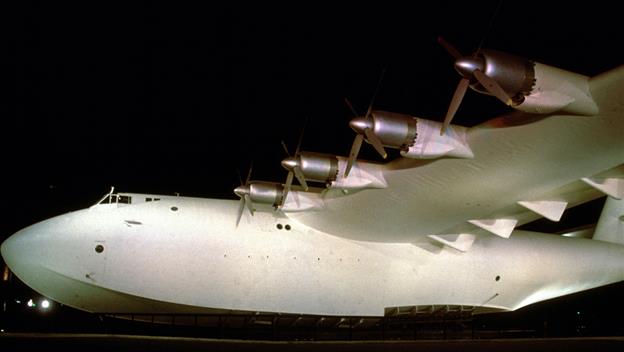
The Hughes Flying Boat—the largest aircraft ever built—is piloted by designer Howard Hughes on its first and only flight. Built with laminated birch and spruce, the massive wooden aircraft had a wingspan longer than a football field and was designed to carry more than 700 men to battle.
Howard Hughes was a successful Hollywood movie producer when he founded the Hughes Aircraft Company in 1932. He personally tested cutting-edge aircraft of his own design and in 1937 broke the transcontinental flight-time record. In 1938, he flew around the world in a record three days, 19 hours, and 14 minutes.
Following the U.S. entrance into World War II in 1941, the U.S. government commissioned the Hughes Aircraft Company to build a large flying boat capable of carrying men and materials over long distances. The concept for what would become the “Spruce Goose” was originally conceived by the industrialist Henry Kaiser, but Kaiser dropped out of the project early, leaving Hughes and his small team to make the H-4 a reality. Because of wartime restrictions on steel, Hughes decided to build his aircraft out of wood laminated with plastic and covered with fabric. Although it was constructed mainly of birch, the use of spruce (along with its white-gray color) would later earn the aircraft the nickname Spruce Goose. It had a wingspan of 320 feet and was powered by eight giant propeller engines.
Development of the Spruce Goose cost a phenomenal $23 million and took so long that the war had ended by the time of its completion in 1946. The aircraft had many detractors, and Congress demanded that Hughes prove the plane airworthy. On November 2, 1947, Hughes obliged, taking the H-4 prototype out into Long Beach Harbor, CA for an unannounced flight test. Thousands of onlookers had come to watch the aircraft taxi on the water and were surprised when Hughes lifted his wooden behemoth 70 feet above the water and flew for a mile before landing.
Despite its successful maiden flight, the Spruce Goose never went into production, primarily because critics alleged that its wooden framework was insufficient to support its weight during long flights. Nevertheless, Howard Hughes, who became increasingly eccentric and withdrawn after 1950, refused to neglect what he saw as his greatest achievement in the aviation field. From 1947 until his death in 1976, he kept the Spruce Goose prototype ready for flight in an enormous, climate-controlled hangar at a cost of $1 million per year. Today, the Spruce Goose is housed at the Evergreen Aviation Museum in McMinnville, Oregon.
 

Monday, 31 October 2016

Today in history

1517

Martin Luther posts 95 theses


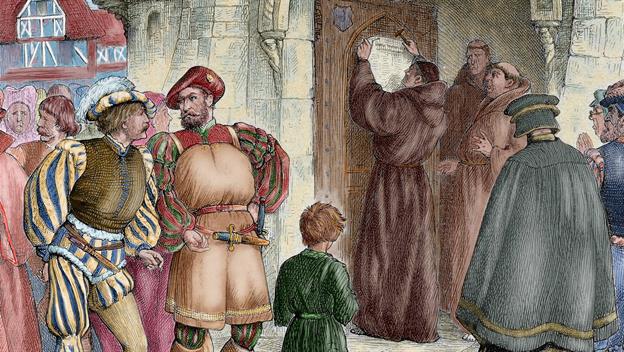
On this day in 1517, the priest and scholar Martin Luther approaches the door of the Castle Church in Wittenberg, Germany, and nails a piece of paper to it containing the 95 revolutionary opinions that would begin the Protestant Reformation.
In his theses, Luther condemned the excesses and corruption of the Roman Catholic Church, especially the papal practice of asking payment—called “indulgences”—for the forgiveness of sins. At the time, a Dominican priest named Johann Tetzel, commissioned by the Archbishop of Mainz and Pope Leo X, was in the midst of a major fundraising campaign in Germany to finance the renovation of St. Peter’s Basilica in Rome. Though Prince Frederick III the Wise had banned the sale of indulgences in Wittenberg, many church members traveled to purchase them. When they returned, they showed the pardons they had bought to Luther, claiming they no longer had to repent for their sins.
Luther’s frustration with this practice led him to write the 95 Theses, which were quickly snapped up, translated from Latin into German and distributed widely. A copy made its way to Rome, and efforts began to convince Luther to change his tune. He refused to keep silent, however, and in 1521 Pope Leo X formally excommunicated Luther from the Catholic Church. That same year, Luther again refused to recant his writings before the Holy Roman Emperor Charles V of Germany, who issued the famous Edict of Worms declaring Luther an outlaw and a heretic and giving permission for anyone to kill him without consequence. Protected by Prince Frederick, Luther began working on a German translation of the Bible, a task that took 10 years to complete.
The term “Protestant” first appeared in 1529, when Charles V revoked a provision that allowed the ruler of each German state to choose whether they would enforce the Edict of Worms. A number of princes and other supporters of Luther issued a protest, declaring that their allegiance to God trumped their allegiance to the emperor. They became known to their opponents as Protestants; gradually this name came to apply to all who believed the Church should be reformed, even those outside Germany. By the time Luther died, of natural causes, in 1546, his revolutionary beliefs had formed the basis for the Protestant Reformation, which would over the next three centuries revolutionize Western civilization.


Saturday, 29 October 2016

Today in history

1998

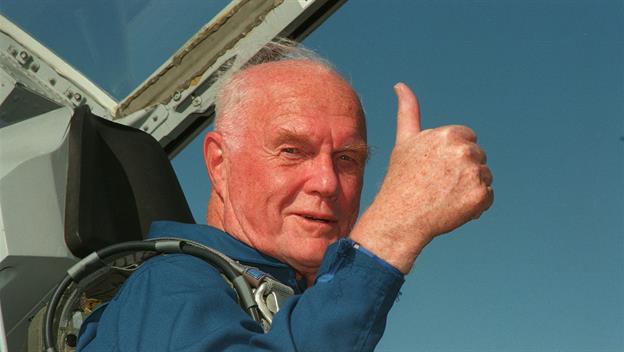
John Glenn returns to space


Nearly four decades after he became the first American to orbit the Earth, Senator John Hershel Glenn, Jr., is launched into space again as a payload specialist aboard the space shuttle Discovery. At 77 years of age, Glenn was the oldest human ever to travel in space. During the nine-day mission, he served as part of a NASA study on health problems associated with aging.
Glenn, a lieutenant colonel in the U.S. Marine Corps, was among the seven men chosen by the National Aeronautics and Space Administration (NASA) in 1959 to become America’s first astronauts. A decorated pilot, he had flown nearly 150 combat missions during World War II and the Korean War. In 1957, he made the first nonstop supersonic flight across the United States, flying from Los Angeles to New York in three hours and 23 minutes.
In April 1961, Soviet cosmonaut Yuri Gagarin was the first man in space, and his spacecraft, Vostok 1, made a full orbit before returning to Earth. Less than one month later, American Alan B. Shepard, Jr., became the first American in space when his Freedom 7 spacecraft was launched on a suborbital flight. American “Gus” Grissom made another suborbital flight in July, and in August Soviet cosmonaut Gherman Titov spent more than 25 hours in space aboard Vostok 2, making 17 orbits. As a technological power, the United States was looking very much second-rate compared with its Cold War adversary. If the Americans wanted to dispel this notion, they needed a multi-orbital flight before another Soviet space advance arrived.
On February 20, 1962, NASA and Colonel John Glenn accomplished this feat with the flight of Friendship 7, a spacecraft that made three orbits of the Earth in five hours. Glenn was hailed as a national hero, and on February 23 President John F. Kennedy visited him at Cape Canaveral. Glenn later addressed Congress and was given a ticker-tape parade in New York City.
Out of a reluctance to risk the life of an astronaut as popular as Glenn, NASA essentially grounded the “Clean Marine” in the years after his historic flight. Frustrated with this uncharacteristic lack of activity, Glenn turned to politics and in 1964 announced his candidacy for the U.S. Senate from his home state of Ohio and formally left NASA. Later that year, however, he withdrew his Senate bid after seriously injuring his inner ear in a fall from a horse. In 1970, following a stint as a Royal Crown Cola executive, he ran for the Senate again but lost the Democratic nomination to Howard Metzenbaum. Four years later, he defeated Metzenbaum, won the general election, and went on to win reelection three times. In 1984, he unsuccessfully sought the Democratic nomination for president.
In 1998, Glenn attracted considerable media attention when he returned to space aboard the space shuttle Discovery. In 1999, he retired from his U.S. Senate seat after four consecutive terms in office, a record for the state of Ohio.
 

Friday, 28 October 2016

Today in history

1965

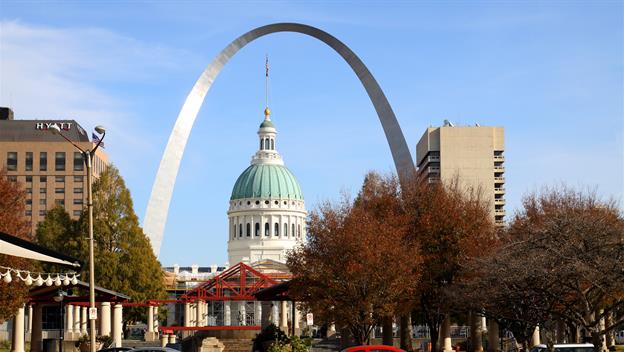
Gateway Arch completed


On this day in 1965, construction is completed on the Gateway Arch, a spectacular 630-foot-high parabola of stainless steel marking the Jefferson National Expansion Memorial on the waterfront of St. Louis, Missouri.
The Gateway Arch, designed by Finnish-born, American-educated architect Eero Saarinen, was erected to commemorate President Thomas Jefferson’s Louisiana Purchase of 1803 and to celebrate St. Louis’ central role in the rapid westward expansion that followed. As the market and supply point for fur traders and explorers—including the famous Meriwether Lewis and William Clark—the town of St. Louis grew exponentially after the War of 1812, when great numbers of people began to travel by wagon train to seek their fortunes west of the Mississippi River. In 1947-48, Saarinen won a nationwide competition to design a monument honoring the spirit of the western pioneers. In a sad twist of fate, the architect died of a brain tumor in 1961 and did not live to see the construction of his now-famous arch, which began in February 1963. Completed in October 1965, the Gateway Arch cost less than $15 million to build. With foundations sunk 60 feet into the ground, its frame of stressed stainless steel is built to withstand both earthquakes and high winds. An internal tram system takes visitors to the top, where on a clear day they can see up to 30 miles across the winding Mississippi and to the Great Plains to the west. In addition to the Gateway Arch, the Jefferson Expansion Memorial includes the Museum of Westward Expansion and the Old Courthouse of St. Louis, where two of the famous Dred Scott slavery cases were heard in the 1860s.
Today, some 4 million people visit the park each year to wander its nearly 100 acres, soak up some history and take in the breathtaking views from Saarinen’s gleaming arch.